
Subscribe to our WhatsApp Channel
Every few years, El Niño returns, and every time it does, social media fills with fear. This June, NOAA officially declared a new El Niño event, and within days, Sri Lankan social media was flooded with warnings of imminent drought, catastrophic destruction from a “Super El Niño,” and claims that Sri Lanka would soon have no rainfall at all. Some of those claims are exaggerated. Some are outright wrong. Below is our full explainer, grounded in what science and Sri Lanka’s Department of Meteorology actually say.
Bottom Line (Summary) : Although El Niño was officially declared globally in June 2026, the rainfall Sri Lanka is currently receiving is driven by the active southwest monsoon, not El Niño. Sri Lanka is not experiencing a severe drought at present. El Niño’s impacts are expected to emerge from July, particularly by August, and may persist for 9 to 12 months.
Social Media Posts :
As rainy conditions continued across parts of Sri Lanka, social media users raised questions about why rainfall was persisting despite the onset of El Niño: Facebook | Archived Link

Separately, stark warning posts about El Niño circulated as follows:
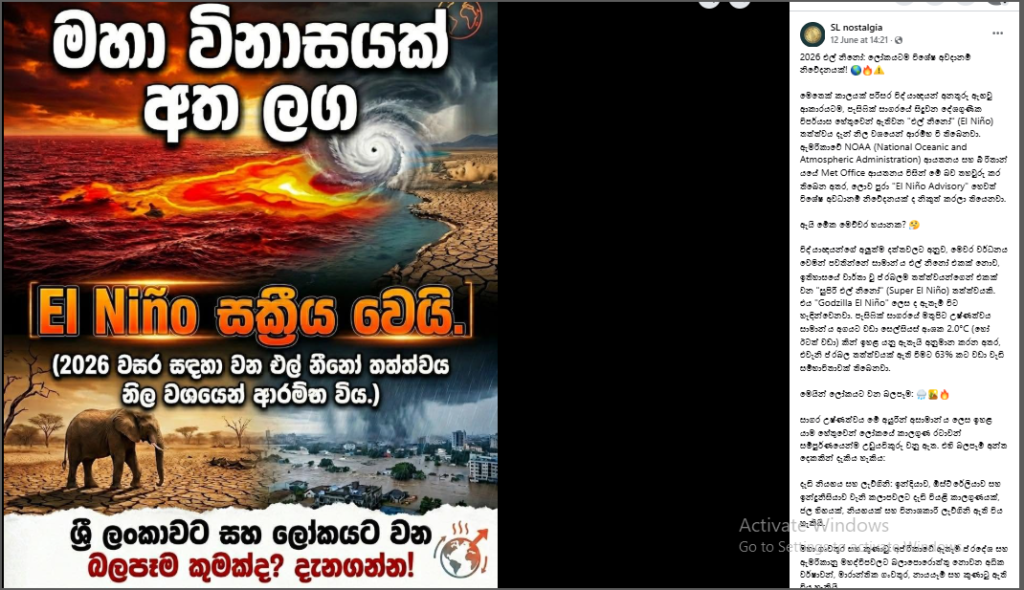
These posts put forward three main claims: (1) El Niño will very soon bring a severe drought to Sri Lanka; (2) a “Super El Niño” event is coming and will bring catastrophic destruction; and (3) during an El Niño event, rainfall disappears entirely.
In response to reader requests, we examined each of these claims against the available evidence.
Explainer :
What Is El Niño?
El Niño is a natural climate phenomenon in which sea surface temperatures near the equator of the Pacific Ocean rise abnormally, altering atmospheric pressure patterns and generating weather changes across the world. Under normal conditions, winds blowing across the ocean push warm surface water in the Pacific westward, toward the Asian region. When these winds weaken or reverse direction, that warm water accumulates instead toward South America. Scientists measure this primarily using the Niño 3.4 Index: when the surface temperature anomaly exceeds +0.5°C, the situation is classified as an El Niño event. More information is available here and here.
How Does El Niño Affect the World?
El Niño triggers contrasting climate extremes worldwide. In South and Southeast Asia including Indonesia, Malaysia, Australia, the Philippines, and India it weakens monsoon rainfall, leading to prolonged dry conditions, water shortages, and heightened wildfire risks. In contrast, Pacific coastal regions of South America, particularly Peru and Ecuador, as well as the southern United States, often receive excessive rainfall, resulting in widespread flooding and landslides. Further information is available here and here.
Early Regional Signs Are Already Visible
The World Meteorological Organization (WMO) expects below-average monsoon rainfall in South Asia this season. India’s Meteorological Department (IMD) forecasts the 2026 southwest monsoon at just 90% of its long-term average, with the onset already delayed by a few days. South India, Australia, and Indonesia may face severe dry conditions, potentially affecting Sri Lanka indirectly through disruptions to food exports. WMO; IMD forecast.
El Niño: History and Current Status
El Niño is a naturally recurring climate phenomenon that occurs every 2 to 7 years. Major events were recorded in 1982–83, 1997–98, and 2015–16. Some studies suggest that human-induced global warming has intensified El Niño events in recent decades. Additional information is available here.
What Happened to Sri Lanka During Previous El Niño Events?
During the powerful 2015–16 El Niño, Sri Lanka first experienced early water shortages, and dry conditions, then devastating May 2016 floods and landslides, including the Aranayake disaster. A prolonged drought then gripped the country through late 2016 and 2017, affecting over 2 million people in 17 districts. This cycle exemplifies “climate whiplash”: rapid shifts between extreme wet and dry conditions within the same El Niño episode. Therefore, it is clear that El Niño can bring not only drought but also destructive flooding. World Bank PDNA Report.
This Is Not a Short-Lived Situation
El Niño typically lasts 9 to 12 months. The Department of Meteorology expects its effects to continue through February 2027. It should be understood as a long-term evolving climate process, not a brief episode. Human-induced climate change is intensifying its impacts, while both the Asian Development Bank and the World Bank classify Sri Lanka as highly vulnerable to climate-related threats. ADB.
On 11 June 2026, NOAA Officially Declared an El Niño Event
NOAA’s Climate Prediction Center (NOAA CPC) officially declared the onset of El Niño on 11 June 2026, noting a 63% chance it will become “very strong” between November 2026 and January 2027. The WMO projects an 80% probability for June–August, surging to 90% thereafter. With the Niño 3.4 sea surface temperature anomaly already at +0.7°C, global temperatures are expected to remain well above average in the coming months. Further information is available here, here, and here.
The Impact on Sri Lanka as of June 2026
According to Sri Lanka’s Department of Meteorology, El Niño conditions may weaken the southwest monsoon, reducing rainfall across the country. Lower rainfall could decrease inflows to the central highlands’ major reservoirs that support hydroelectric power generation. Dry and warmer conditions may also affect tea and coconut production and complicate water management for rice cultivation during the upcoming Maha season. The Department advises the public and relevant authorities to conserve water and follow its official daily weather bulletins closely. Additional information is available here and here.
In an April 2026 joint statement, the World Bank, IMF, and World Food Programme warned that the developing El Niño could seriously threaten crop production across South Asia, with rice yields potentially declining by 20%–50%. Significant impacts on major food-exporting regions such as South India and Australia could indirectly affect Sri Lanka. World Bank.
Why Is Sri Lanka Receiving Rainfall Right Now?
The rainfall Sri Lanka is receiving in June 2026 is due to the active and well-established southwest monsoon, which is prevailing across the island. El Niño has not yet materially affected Sri Lanka’s monsoon. Further information is available at meteo.gov.lk.
El Niño Is Not Yet Affecting Sri Lanka Directly
Although El Niño has officially developed in the Pacific, its direct impacts on Sri Lanka including drier conditions and a weaker monsoon are expected to emerge gradually. According to Department of Meteorology forecasts, southwest monsoon rainfall is proceeding normally in June, with El Niño-related rainfall reductions likely to become evident only toward the latter part of 2026. Further information is available here.
Claims vs Reality: What Social Media Says and What the Evidence Shows
| Claim circulating on social media | The actual situation |
|---|---|
| El Niño will cause Sri Lanka’s rainfall to disappear entirely, bringing a severe drought very soon. | Southwest monsoon rainfall in Sri Lanka is currently operating normally. El Niño-related rainfall reductions are expected to emerge in July–August 2026. Here |
| A “Super El Niño” event will plunge the entire world into an unprecedented catastrophe. | “Super El Niño” is a media label, not a scientific classification. What may develop is a “Very Strong” El Niño event. The WMO does not use “Super El Niño” as an official category. A very strong event is serious but not synonymous with global destruction. |
| Throughout the entire duration of El Niño, Sri Lanka’s rainfall will disappear completely. | El Niño may suppress monsoon rainfall in the Western and Southern Provinces. But when the northeast monsoon activates in November–December, the Northern and Eastern Provinces could face above-average rainfall and flooding. El Niño produces climate whiplash, not permanent drought. |
| El Niño is a condition newly created by human environmental pollution. | El Niño is a natural climate cycle that has been occurring on Earth for thousands of years. Human-induced global warming may be intensifying its strength to some degree, but it is not a newly created phenomenon. |
Mr. Ajith Wijemanna, Acting Director General, Department of Meteorology
In our interview with Mr. Ajith Wijemanna, he noted that El Niño awareness has been growing on social media but that much of the content is misleading and exaggerated, creating unnecessary public alarm. He emphasized that El Niño is not as severe as often portrayed online and that it does not equate to total drought. He pointed out that social media discussions have focused almost exclusively on drought risks, giving far less attention to the equally significant threats of above-average rainfall and flooding that can also accompany an El Niño event.
While El Niño has affected the country, Mr. Wijemanna emphasized that its intensity does not warrant unnecessary public fear. He noted that El Niño could increase drought risk, particularly in South India, and may have significant impacts on Australia and Indonesia. Acting DG also warned that droughts in South India and Australia could restrict food exports, and that food security is a vital concern.
Northern Sri Lanka may experience some dry conditions, he said, but the country as a whole is unlikely to face severe impacts. At present, El Niño remains weak but is forecast to strengthen to a moderate level, with the potential to become strong. If that occurs, peak intensity is expected between December and February.
Although more rainfall than expected fell during May–June, a reduction in rainfall is anticipated in July–August, and some drought conditions may occur. Temperatures may be higher in months like August, but not at an intolerable level.
Mr. Ajith Wijemanna explained that when the second inter-monsoon season begins in September, Pacific Ocean conditions could strengthen monsoon activity and increase rainfall. Under El Niño conditions, October and November may bring heavy rainfall, strong winds, floods, and landslides. Between January and April 2027, rainfall may decrease again, and the effects of El Niño-related drought could be significant during this period.
Climate Misinformation: A Recognized Global Problem
The kind of exaggerated, fear-driven content spreading about El Niño on Sri Lankan social media is not unique to Sri Lanka. Climate misinformation, including disaster speculation, recycled old footage, and AI-generated images, is a documented global phenomenon tracked by international fact-checkers. The WMO has issued specific guidance on responsible communication of climate hazards precisely because doom-framed messaging can cause unnecessary public panic and actually reduce preparedness rather than improve it.
The 45–55°C WhatsApp hoax from March 2026 is a clear local example. A message falsely claimed temperatures of 45–55°C would occur from late April through May. The Department of Meteorology confirmed no such warning had been issued. Such confusion often arises from conflating the heat index (the “feels like” temperature) with the actual recorded air temperature, which are two distinct measurements. That fact-check is available here.
Join us to learn more about our fact-check investigations.
Facebook | Twitter | Instagram | Google News | TikTok | YouTube
Conclusion :
Several claims circulating on Sri Lankan social media about El Niño are misleading or false. El Niño does not mean rainfall disappears entirely, it is not a newly human-created phenomenon, and “Super El Niño” is a media label with no official scientific classification. The rainfall Sri Lanka is currently receiving in June 2026 is driven by the active southwest monsoon, not El Niño. Sri Lanka is not experiencing a severe drought at present.
Acting Director General Ajith Wijemanna of the Department of Meteorology confirmed that El Niño is currently at a weak level, that both dry and wet periods can occur during its cycle, and that the country as a whole is unlikely to face severe impacts. Rainfall reductions are expected from July–August. The situation may persist until approximately February 2027, bringing both drought risk and episodes of above-average rainfall and flooding. The public is advised to conserve water and follow official meteorological advisories.
Sources :
1. NOAA CPC — ENSO Diagnostic Discussion (11 June 2026)
2. WMO — Prepare for El Niño (June 2026)
3. Daily Mirror — Sri Lanka braces for severe heat in July–August
4. Ada Derana — Drought likely in July–August
5. The Morning — El Niño: possible drought in July–August
6. World Bank/IMF/WFP — Food Security Update (April 2026)
7. IMD 2026 Monsoon forecast (Business Standard)
8. ADB — Climate Risk Country Profile: Sri Lanka
9. Climate Fact Checks — 45–55°C heat hoax debunks
10. World Bank — 2016 Sri Lanka floods PDNA

Title: El Niño Has Arrived: What Is True, What Is Exaggerated, and What Sri Lanka Actually Needs to Know!
Fact Check By: Factcrescendo Team
Result: Insight