

Subscribe to our WhatsApp Channel
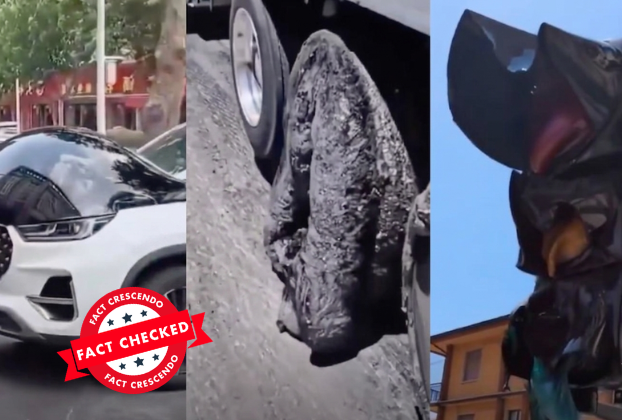
Footage of traffic lights, shopping trolleys, and car parts appearing to melt has been spreading across social media recently, shared with captions claiming Europe’s heatwave has become so extreme that everyday objects are physically liquefying in the heat. The clips have reached Sri Lankan social media feeds as well, alongside posts warning of global catastrophe. The heatwave is real, severe, and unprecedented. But the specific videos being shared are not what they are claimed to be. We investigated.
Social Media Posts :
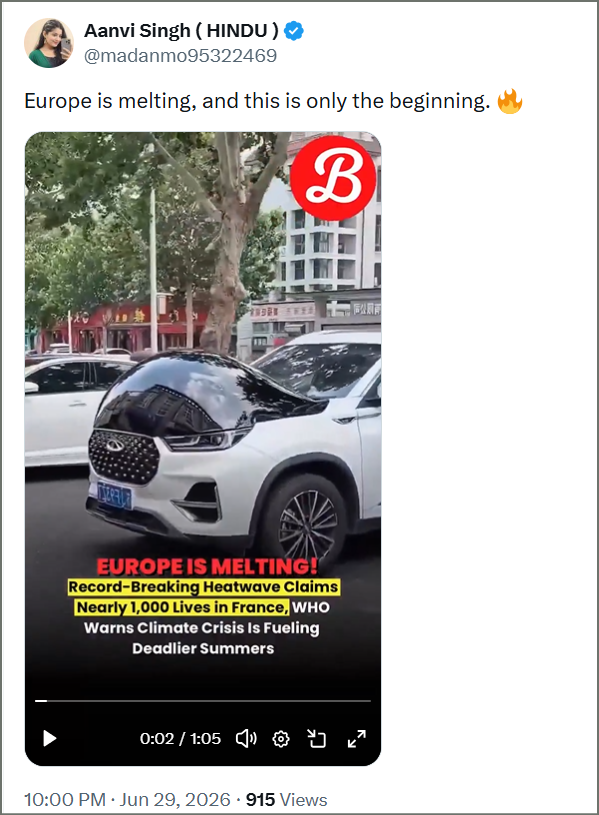
Videos and images circulated across X (formerly Twitter), Instagram, TikTok, and Facebook claiming to show traffic lights melting at intersections in Italy and Germany, shopping trolleys softening and collapsing in the heat, and car components deforming due to extreme temperatures. Many posts attributed this to temperatures of 40 to 45 degrees Celsius across Europe. One widely shared footage shown below.
Here is another instance of the same claim here. The videos were widely shared on X, Instagram, and TikTok.
An additional instance of viral footage has emerged, purporting to show a traffic signal liquefying amidst the heat across the European continent.
We investigated the origin of each visual.
Fact-Check
Video 1: The Clip Does Not Show Europe

A closer examination of the viral video reveals several inconsistencies with the claim that it was filmed in Europe. The vehicle’s license plate visible in the footage begins with the Chinese character “苏” (Su) followed by the letter “J”, a registration code assigned to Yancheng City in Jiangsu Province, China, rather than any European country. This license plate format is consistent with mainland China’s vehicle registration system. (Source)
In addition, signage visible behind the vehicle is written in Chinese, further indicating that the footage was not recorded in Europe.
Video 2:
Traffic Light Footage:
Upon conducting a Google Reverse Image Search of the second visual, we identified the actual location as Berlin, Germany.
The Deutsche Presse-Agentur (DPA) confirmed that the compromised traffic signal is situated within the Friedrichshain-Kreuzberg district of the city.
The DPA reported that this specific structural damage resulted from a fire that devastated the Wilde Renate techno club in June 2025.
Our investigation further established that German news outlets documented the blaze, with the buildings in the background of the source footage clearly matching the visuals currently circulating on social media.
We verified the location using Google Maps.
The architectural details of the white building and the immediate environment perfectly align with the viral footage, confirming that the event occurred at this precise site rather than being caused by the heatwave.
Regarding the second clip featuring a damaged traffic signal, our investigation led to a report released on 23 June by the Italian media organization Il Baco da Seta. The outlet detailed a car fire that erupted at a primary intersection in Lugagnano, Italy, during the evening hours of that same date.
The account noted that emergency crews successfully suppressed the flames and confirmed that there were no casualties. At the time of publication, the exact origin of the blaze remained under investigation.
Additionally, the same news outlet shared footage of the event on their Facebook profile on 23 June. This visual evidence documents the fire at the precise location depicted in the clips currently circulating across social media platforms.
Other Viral Visuals Are Also Misrepresented
BOOM’s fact-check also examined a separate viral video of bananas appearing to melt and fall off a shop display, also attributed to the European heatwave. A reverse image search established that this video pre-dates the 2026 heatwave entirely.
The pattern across these videos is consistent: dramatic visuals from separate, unrelated incidents are repackaged and shared as evidence of the current heatwave. As one analysis observed, social media rewards eye-catching visuals and sensational headlines, and language barriers compound the problem, allowing a local fire-incident video to be presented as a continent-wide climate crisis.
However, None of this changes the fact that what is happening in Europe right now is genuinely alarming. Debunking specific fabricated videos should not obscure the verified, evidence-based reality.
Record Temperatures Across the Continent
Since late May 2026, Europe has been struck by successive heatwaves. According to Wikipedia’s compiled record, temperature records have been broken in Belgium, Czechia, Denmark, France, Germany, Hungary, Italy, the Netherlands, Poland, Romania, Spain, and the United Kingdom. A second, more severe heatwave began on 17 June, just days before the summer solstice.
France experienced its hottest day since measurements began in 1947, with temperatures reaching 44.3°C in Pissos. In the UK, the previous June record of 35.6°C set in 1957 and 1976 was broken multiple times over three consecutive days. Jersey recorded 39.3°C on 25 June, its highest temperature since records began in 1894. Daytime highs of 40°C or above were recorded across Germany, the Czech Republic, and Poland. Reuters reported that 150 million people were living under extreme heat conditions at the peak of the event.
Over 2,000 Excess Deaths Recorded
The human toll has been severe. The World Health Organization reported on 28 June that more than 1,300 excess deaths had been recorded across Europe since 21 June, including children who died in locked cars and young people who drowned seeking relief in unsupervised swimming spots. By 1 July, Spain’s Ministry of Health reported the total had risen above 2,000. WHO Director-General Tedros Adhanom Ghebreyesus stated: “Right now 150 million people are living under extreme heat, hundreds have died, schools are shut, grids are buckling.”
Climate Science: This Would Have Been “Virtually Impossible” Without Human-Caused Warming
A rapid attribution study by World Weather Attribution (WWA) found the current heatwave is the most severe ever recorded over the region studied. The study compared the likelihood of similar extremes during past major heatwave years of 1976 and 2003, when global temperatures were cooler. Both daytime highs and nighttime temperatures during this event would have been “virtually impossible” 50 years ago. A similar heatwave in June 1976 would have been 3.5°C cooler, and nighttime temperatures 100 times less likely.
The WWA also analysed 854 cities across 30 European countries and found that 45% have broken or are about to break their all-time records for wet bulb globe temperature, which measures the body’s ability to cool itself through sweating. The higher it climbs, the greater the risk of heat exhaustion and fatal heatstroke. “This summer shows that at 1.4°C of global warming, extreme heat is already reaching the limits of our societies’ ability to cope,” the WWA scientists wrote.
Why Europe Is Heating Faster Than the Rest of the World
According to Al Jazeera’s analysis citing the European Commission’s Copernicus climate change service, Europe has warmed at roughly twice the global average since the 1980s. WHO chief Tedros confirmed that Europe is the fastest-warming continent on Earth. Dr. Akshay Deoras of the University of Reading described this as “loading the dice” towards once-rare extremes: “Think of it like a race where the starting line has been moved much closer to the finish.”
The 2026 heatwave is being sustained by what meteorologists call an “omega block”, a weather pattern named after the Greek letter because of the shape it creates in the atmosphere. Hot, dry air from North Africa becomes trapped over a region as low-pressure systems on either side prevent it from dispersing. Of the 52 heatwaves recorded in France since 1947, French paleoclimatologist Jean Jouzel has pointed out that two-thirds have occurred since the beginning of the 21st century.
What the Science Projects for Coming Decades
WWA’s modelling indicates that at current emissions rates, an event of this magnitude is expected to occur every couple of decades. The UN Economic Commission for Europe (UNECE) has warned that infrastructure faces far worse between 2051 and 2080: extreme weather is expected to pummel roads, railways, waterways, ports, and airports. Rail deformation, road buckling, traffic light malfunctions, and air conditioning failures on trains are already occurring across Belgium, Denmark, France, and the UK during this event. Scientists stress that infrastructure can still be retrofitted and emissions reduced, but the window is narrowing.
Climate Fact Checks, Fact Crescendo’s partner organisation covering climate misinformation, has investigated this specific set of viral videos in detail. Their full analysis is available here.
Join us to learn more about our fact-check investigations.
Facebook | Twitter | Instagram | Google News | TikTok
Conclusion
The viral videos claiming traffic lights, trolleys, and car parts are physically melting under Europe’s 2026 heatwave are misleading. The Milan traffic light was damaged by a car fire directly beneath it. The Berlin traffic light was damaged by a club fire in June 2025 and has no connection to the current heatwave. Other viral footage from the same batch pre-dates the event entirely. These videos do not accurately represent what the heatwave is doing.
The heatwave itself, however, is real and unprecedented. Over 2,000 excess deaths have been recorded since 21 June 2026. World Weather Attribution scientists have found this event to be the most severe ever recorded over Europe and “virtually impossible” without human-caused climate change. Europe is warming at twice the global average, and under current emissions trajectories, events of this scale are expected to occur with increasing frequency in the decades ahead. The fabricated videos are a distraction from a real and serious story.

Title: Europe’s Heatwave Is Breaking Records and Killing People. But the Viral “Melting Traffic Lights” Videos Tell the Wrong Story.
Fact Check By: Fact Crescendo Team
Result: Misleading