
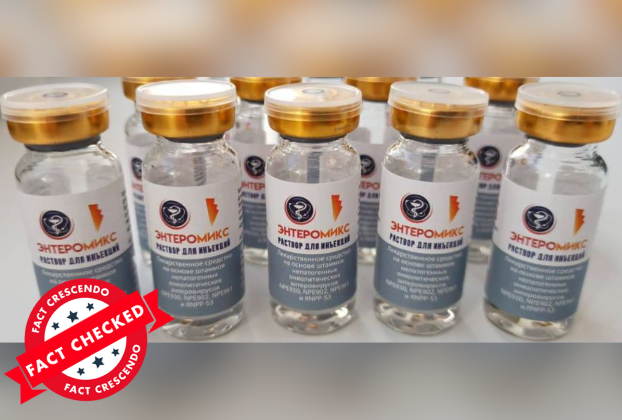
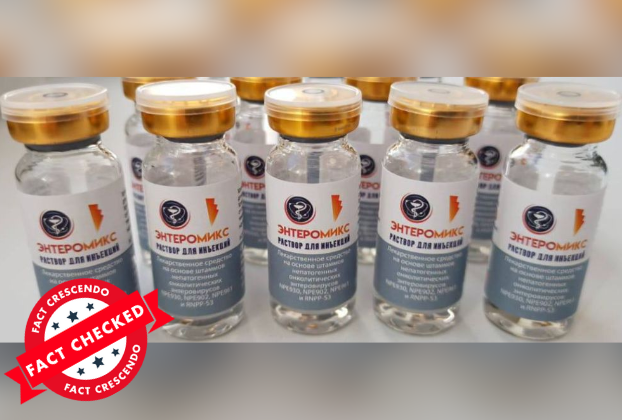
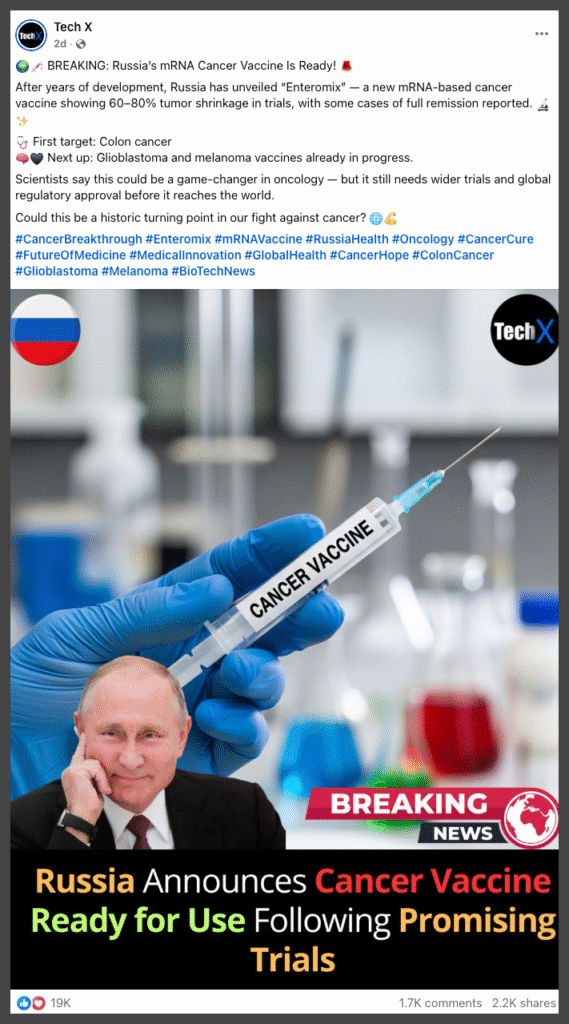
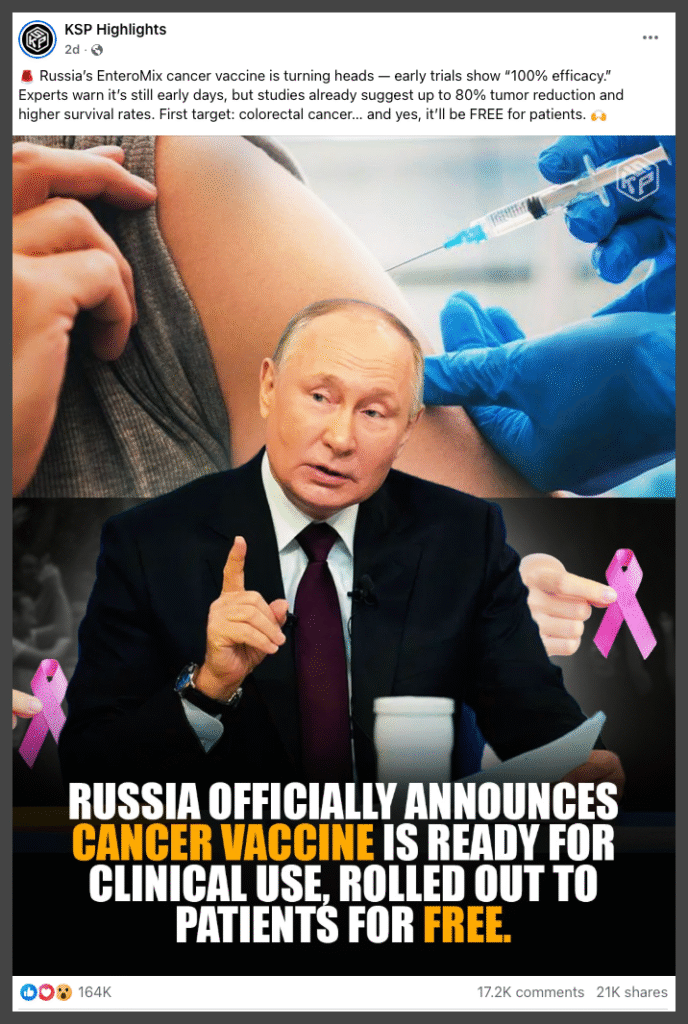
A viral story has been circulating on social media and international news outlets claiming that Russia has developed a new cancer vaccine called Enteromix. Posts and headlines describe it as a breakthrough treatment, with some even stating that it has achieved 100 percent efficacy and will soon be distributed freely in Russia. The story has generated significant interest, but closer examination shows that these claims are scientifically premature and misleading.
Social Media Posts
Across online platforms, users have shared captions such as “Russia’s EnteroMix cancer vaccine is turning heads — early trials show ‘100% efficacy'” or “Russia’s mRNA Cancer Vaccine Is Ready!” Infographics and video clips have further amplified the claim that the vaccine is “ready for clinical use”. Moreover, some posts claimed that Russia would distribute this vaccine free of charge to all patients worldwide.
Fact Check
What is Enteromix?
Enteromix is a personalized cancer treatment that uses mRNA technology. It works by teaching a patient’s immune system to identify and attack cancer cells using genetic material taken from the patient’s own tumor. According to Russian developers, they’ve incorporated artificial intelligence to dramatically reduce production time from months to just hours, as reported by Economic Times. The technology is being developed by Russia’s National Medical Research Radiological Centre in collaboration with the Russian Academy of Sciences. While this approach aligns with global research trends in mRNA cancer treatments, it’s important to note that Enteromix is still in the early phases of development.
Problems with the Clinical Evidence
The evidence for Enteromix has major limitations. Indian Express reported that the trial included only 48 patients with colorectal cancer, whereas proper Phase II trials typically need 100-300 participants with various cancer types. The results haven’t been published in any peer-reviewed scientific journal, which is essential for validating medical claims. Questions remain about whether the study used a control group for comparison, and the follow-up period was much shorter than the 2-5 years typically required by international standards. These significant shortcomings make the claim of 100% effectiveness highly questionable from a scientific perspective.
Dr. Dhiren Bhatia, a clinical oncologist and former adviser to the WHO’s cancer research division, explained to India Today that claims of “100 percent efficacy” in a Phase I trial need to be treated with caution. He noted that the Enteromix trial involved only 48 patients, which is far too small to draw conclusions for the wider population. Just as importantly, the findings have not been peer-reviewed or independently validated.
According to Dr. Bhatia, the scientific community would expect to see raw data, biomarker analysis, and survival outcomes such as progression-free and overall survival measured beyond 6–12 months. Without these critical details, Enteromix should be regarded as an interesting but still unproven intervention rather than a breakthrough cancer cure.
The “Free to All Patients” Claim
In reality, Russian officials, including President Vladimir Putin, announced only that the vaccine would be made available free of charge to cancer patients in Russia once it is approved, with rollout expected in late 2025. Reports estimate the price at about 300,000 rubles per dose (around USD 2,870), which the Russian state intends to cover for its own citizens. (Source)
There is no evidence of Russia offering free access beyond its domestic population. International outlets such as Reuters and Newsweek also highlight the absence of any global supply or financing plan. Claims that Enteromix will be offered free to all patients worldwide are, therefore, misleading and exaggerate the official announcements.
How It Compares to Other Programs
Comparing Enteromix to established mRNA cancer vaccine programs reveals significant differences in research quality. While BioNTech/Pfizer and Moderna/Merck conduct large Phase II trials with hundreds of patients across multiple cancer types, Russia’s program tested only 48 patients.
BioNTech and Pfizer are running multiple Phase II trials with sample sizes in the hundreds, with results published in leading journals such as Nature. Moderna, in partnership with Merck, has reported a 40–50% reduction in recurrence risk in a Phase II melanoma trial, with findings peer-reviewed and published in The Lancet. These companies provide transparent updates about their progress. In contrast, Russia has shared minimal information from its small trial while making remarkably high success claims without peer-reviewed validation.
Why Cancer Vaccines Differ From COVID-19 Vaccines
Some viral posts draw parallels between Enteromix and COVID-19 mRNA vaccines, suggesting that success with coronavirus vaccines guarantees similar results for cancer, which is not accurate. COVID-19 vaccines target external viruses that are clearly foreign to our bodies, making them easier for the immune system to recognize.
Cancer, however, develops from our own cells, making it much harder for the immune system to identify and attack without harming healthy tissue. While mRNA technology has shown promise in both areas, cancer vaccines face unique challenges that require more extensive testing, longer development periods, and thorough safety assessments before they can be considered effective treatments. (Source)
Risks of False Hope for Patients
Medical experts warn that sharing early research results without proper peer review can mislead patients about available treatments. When scientific findings aren’t thoroughly vetted, patients might hope for outcomes that aren’t realistic. Doctors stress that following proper scientific procedures, especially peer review, is essential for providing the public with accurate information about new medical treatments (Source).
Regulatory Status and Safety Concerns
In Russia, Enteromix is still awaiting approval from the Ministry of Health, with rollout projected for late 2025 (Source). Internationally, there have been no submissions to the U.S. Food and Drug Administration, the European Medicines Agency, or the World Health Organization. Long-term safety, immune interactions, and drug interactions remain untested, and the vaccine has so far been trialed only in a narrow patient group. Without broader and longer studies, it cannot be considered ready for clinical use.
Conclusion
The claim that Enteromix has achieved 100 percent efficacy against cancer, or that it is already “ready for clinical use,” is misleading and unverified. The vaccine is an experimental therapy that has shown early signals of potential in a very small trial, but its effectiveness and safety have not been proven. No peer-reviewed data, independent validation, or large-scale clinical trials support the dramatic claims being made.
Moreover, while Russian authorities have pledged to provide Enteromix free of charge to domestic cancer patients if approved, there is no evidence that the vaccine will be distributed free to patients worldwide.

Title:Russia’s Enteromix Cancer Vaccine Has Not Proven 100% Efficacy in Clinical Trials
Fact Check By: Cielito WangResult: Misleading