

A viral claim circulating across social media platforms suggests that scientists have discovered cannabis can “kill” hantavirus. However, no credible scientific evidence shows that cannabis can kill or treat hantavirus infection in humans. While some laboratory studies have explored the antiviral potential of certain cannabis compounds against a range of viruses, no reputable medical authority or peer-reviewed study has demonstrated that cannabis can kill hantavirus in humans.
Social Media Posts
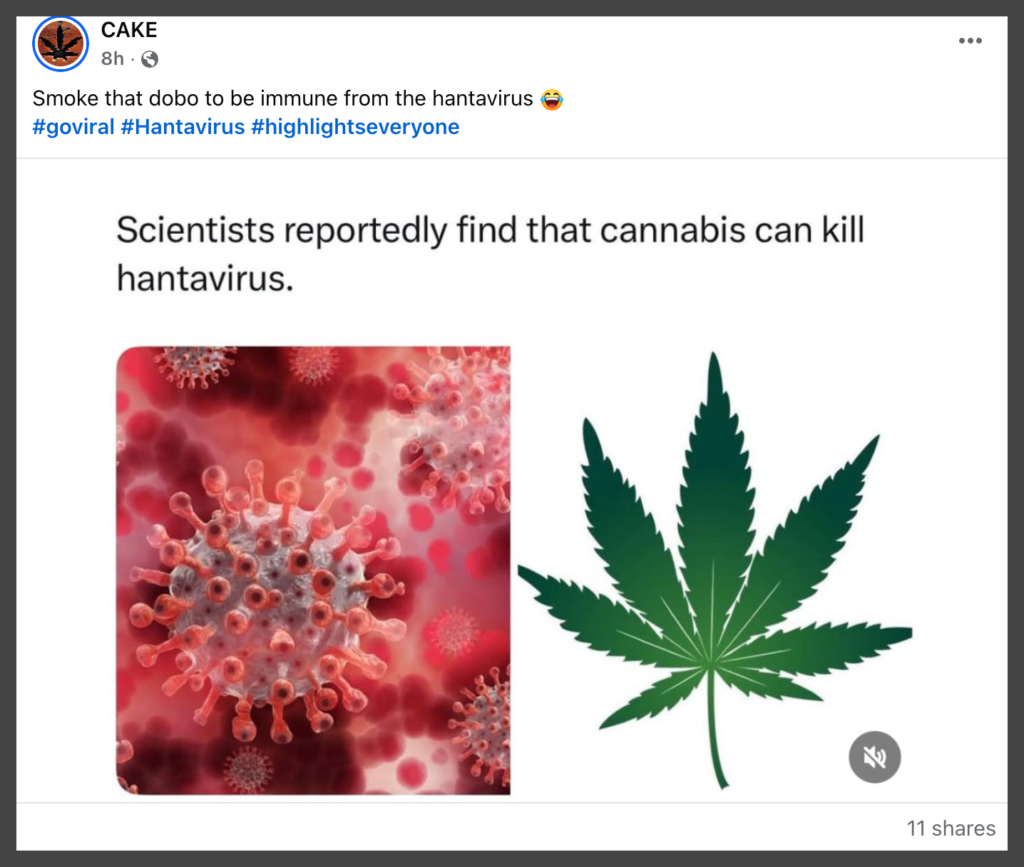
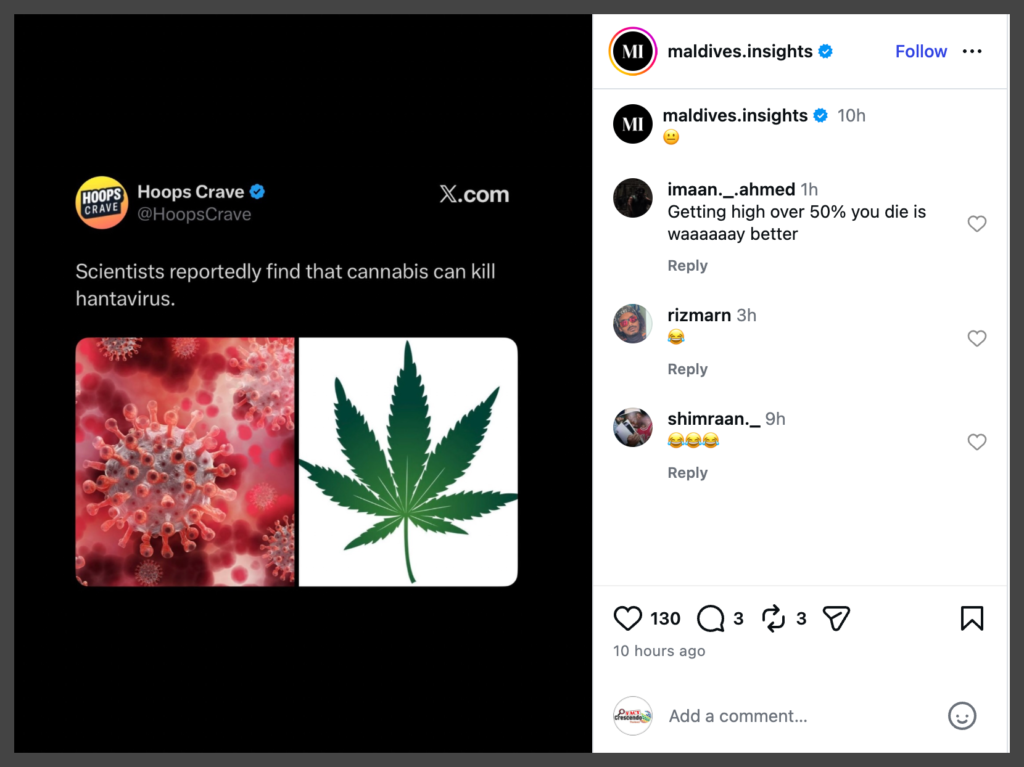
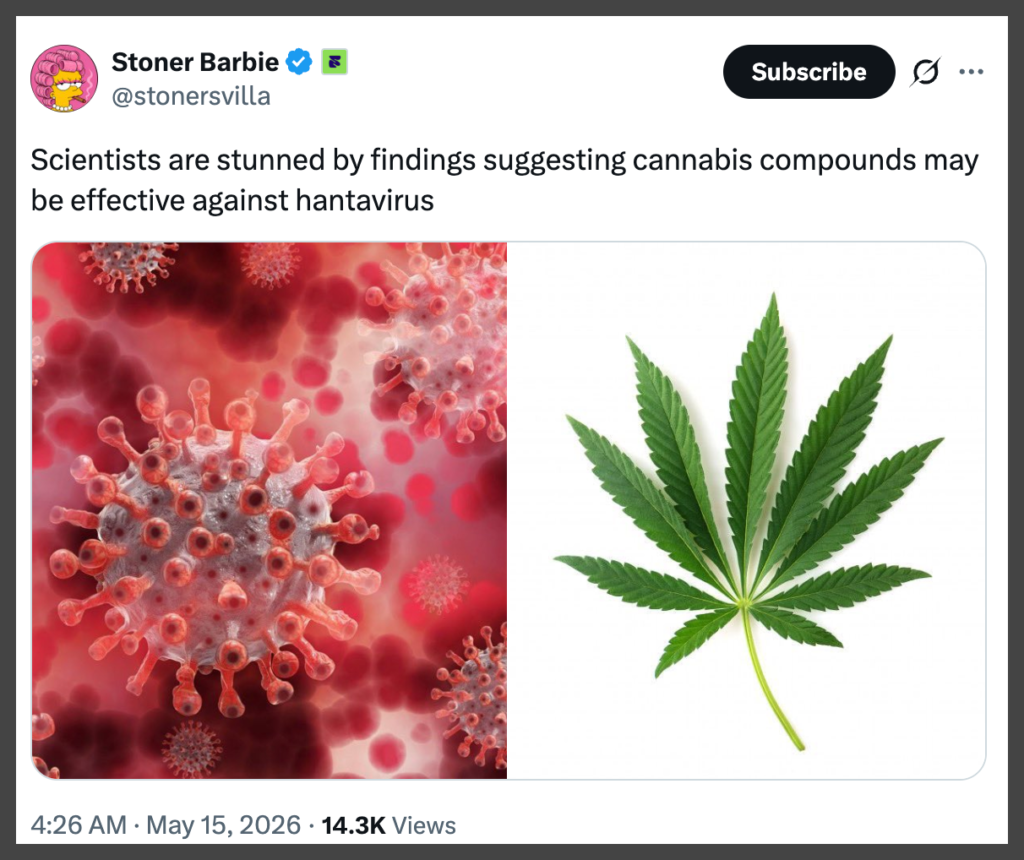
Multiple posts on Facebook, Instagram, and X shared the claim that “Scientists reportedly find that cannabis can kill hantavirus.”
Fact Check
What Is Hantavirus?
Hantaviruses are rodent-borne viruses that can cause serious illness in people, including Hantavirus Pulmonary Syndrome (HPS) and Hemorrhagic Fever with Renal Syndrome (HFRS).
They spread mainly through contact with infected rodent urine, droppings, or saliva, especially when contaminated dust is inhaled. Most strains don’t spread easily between people, though the Andes strain can.
The WHO and CDC say there’s no specific antiviral cure or vaccine; treatment is supportive (oxygen, fluids, and intensive care when needed).
While no antiviral treatment is formally approved for hantavirus infection, some studies and public health guidance note that intravenous ribavirin has been used off-label in certain cases of Hemorrhagic Fever with Renal Syndrome (HFRS), particularly when administered early in the disease course. However, outcomes remain variable, and ribavirin has not demonstrated clear effectiveness for Hantavirus Pulmonary Syndrome (HPS), the severe respiratory form more commonly seen in the Americas. WHO and CDC guidance continue to emphasize supportive care as the mainstay of treatment.
ALSO READ: What Is Hantavirus? Understanding the Virus, Recent 2026 Concerns, and Actual Public Health Risks
What Research on Cannabis Actually Shows
The research cited in viral posts is usually not about hantavirus. Most of it looks at whether certain cannabinoids in cannabis or hemp show antiviral effects against other viruses in lab experiments (and sometimes animal studies).
A review in the Journal of Applied Microbiology looked at evidence that cannabinoids and terpenes may show antiviral activity in lab or animal research involving viruses such as SARS-CoV-2, HIV, hepatitis C, and herpes simplex virus. The authors emphasized that clinical trials are still needed before drawing conclusions about real-world medical use.
Likewise, researchers at the Linus Pauling Institute at Oregon State University summarized research suggesting hemp cannabinoids could have antiviral potential in laboratory settings, but they also stressed that this does not prove effectiveness in humans.
Additional peer-reviewed reviews and articles discuss cannabis as a possible antiviral: a Monash University systematic review on cannabis as antivirals and a News-Medical report on cannabidiol and innate immune response against SARS-CoV-2. However, none of these studies conclude that cannabis can kill hantavirus.
These findings remain preclinical, meaning they were observed in laboratory or animal studies and have not been validated in human clinical trials.
No Evidence Cannabis Treats Hantavirus
We found no peer-reviewed study specifically demonstrating that cannabis or cannabinoids can prevent, treat, or eliminate hantavirus infection in humans.
Some research also suggests cannabis smoke exposure may affect immune responses. For example, a study published in Frontiers in Immunology reported that cannabis smoke exposure suppressed antiviral immune responses and increased viral burden during influenza infection in animal models. Findings like this highlight that cannabis use may have complex, context-dependent effects on the immune system and should not be assumed to improve antiviral defenses.
Additional peer-reviewed studies discussing cannabis and immune response: a PMC review on cannabinoids and innate immunity, a Frontiers in Immunology cannabis smoke and influenza study, and a DW fact-check on four cannabis myths. These articles generally note that promising laboratory findings do not necessarily translate into safe or effective treatments in humans.
What Health Organizations Recommend
Major health agencies consistently emphasize prevention, early medical care, and supportive treatment rather than unproven remedies.
The WHO hantavirus fact sheet and CDC recommend reducing exposure to rodents and safely cleaning contaminated environments as the primary prevention strategy. Public health guidance advises against sweeping or vacuuming rodent droppings because doing so can aerosolize virus particles and increase infection risk. Instead, contaminated areas should be disinfected using wet-cleaning methods with bleach or approved disinfectants.
The CDC’s hantavirus prevention guidance: Hantavirus prevention overview and Rodent droppings clean-up guidance.
Other public health agencies including the Public Health Agency of Canada and the European Centre for Disease Prevention and Control (ECDC) also state that there is currently no approved cure for hantavirus infection.
According to the Mayo Clinic hantavirus diagnosis and treatment, early intensive medical care significantly improves survival chances for patients with severe hantavirus disease.
What Should You Do If You Suspect Hantavirus Exposure?
WHO health communication standards require actionable guidance for readers who may be at risk. This section was missing from the original article.
- Avoid sweeping, vacuuming, or disturbing rodent droppings — this aerosolises infectious particles
- Wear an N95 respirator, rubber gloves, and protective clothing when cleaning affected areas
- Disinfect surfaces using a bleach solution (1 part bleach to 10 parts water) or an EPA-approved disinfectant
- Seek immediate emergency medical care if you develop fever, severe muscle aches, or breathing difficulty within 1–8 weeks of potential exposure
- Do not use cannabis, herbal remedies, or any unproven alternative treatment in place of medical care
- Rodent-proof your home: seal gaps, store food in sealed containers, set traps in high-risk areas
Conclusion
The claim that scientists found cannabis can “kill” hantavirus is false. Existing cannabis research involves preliminary laboratory studies on unrelated viruses and does not demonstrate that cannabis can treat or eliminate hantavirus infection in humans.
Major public health authorities including the WHO and CDC continue to state that there is no approved antiviral cure for hantavirus infection, and no medical authority currently recommends cannabis as a treatment.