

Subscribe to our WhatsApp Channel
Due to the current tensions involving the US, Iran, and Israel, many countries around the world have had to face an energy crisis to some extent. Despite the crisis, Sri Lanka maintained fuel supplies, but the Ceylon Petroleum Corporation raised fuel prices on several occasions.
In this context, claims that Sri Lanka purchased crude oil at the highest price per barrel in the world market have been published in mainstream media as well as on social media platforms. We have taken steps to fact-check the claim.
Social Media Posts:
The post claimed that the HSBC chief had stated at an international conference that Sri Lanka had paid $286 for a barrel of oil while other countries paid $150. The owner of the relevant social media account shared the post, saying that this was another multi-billion-dollar robbery.

Facebook | Archived Link Facebook | Archived Link
The post claimed that the HSBC chief had stated at an international conference that Sri Lanka had paid $286 for a barrel of oil while other countries paid $150. The owner of the relevant social media account shared the post, saying that this was another multi-billion-dollar robbery. The posts can be seen here Archived Link and here Archived Link
This clarification addresses the issues raised on social media about whether Sri Lanka has paid a high price per barrel of oil and whether the head of HSBC has made such a statement.
Explainer:
Since a statement allegedly made by the CEO of HSBC Bank that Sri Lanka had paid a whopping sum of $286 for a barrel of crude oil was based on social media posts, we first investigated the facts of the statement made by the CEO.
Content of the statement made by the HSBC CEO
Several foreign websites reported that HSBC CEO George Elhadary made comments at an investment conference held in Hong Kong last week about the impact of the closure of the Strait of Hormuz on the global economy amid the military situation in the Middle East. The CEO’s comments, which also mentioned Sri Lanka, were reported by theMiddle East Eye website with the headline “Sri Lankan buyer pays $286 for a barrel of oil.”Sherwood.news had previously reported the story and quoted the CEO’s statement.
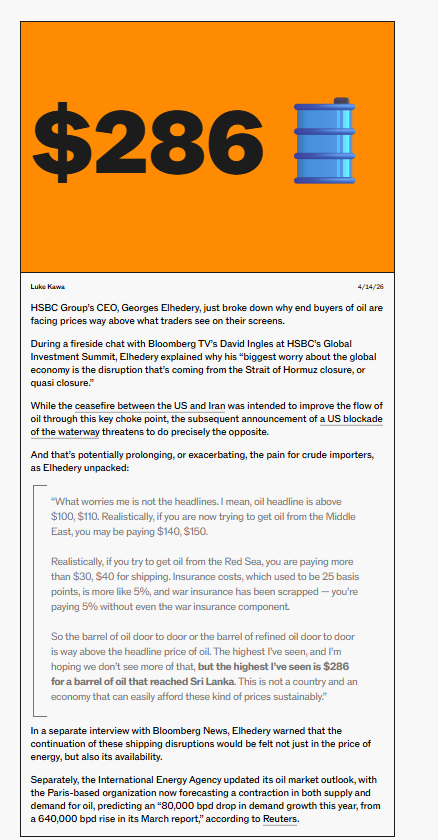
Its Sinhala translation is as follows:
“I’m not worried about the headlines. I mean, the headlines say oil is up to $100 or $110. But in practice, if you try to get oil from the Middle East right now, you might have to pay $140 or $150. The reality is, if you try to get oil across the Red Sea, you’re paying more than $30 or $40 in shipping costs for a barrel of oil.
And even without war insurance, you have to pay about 5%. After including transportation, insurance, fuel refining, and other costs, the price of a barrel of oil becomes much higher by the time it is finally delivered.
The highest price I have seen is $286; that is the price paid for a barrel of oil that Sri Lanka received. Maintaining such a price for a long period of time is not easy for a country and economy like Sri Lanka.”
Although the HSBC CEO stated that it was a barrel of oil, the CEO did not directly state whether it was crude oil or refined fuel. Sri Lanka is a country that meets its energy needs by importing refined fuel as well as crude oil.
How did the local media report the HSBC CEO’s statement?
Sri Lanka has purchased crude oil at the highest price in the world market, that is, $286 per barrel, according to the Middle East Eye website, and the country’s mainstream media, including electronic media, reported the news as follows: thus, thus, thus, and thus.
However, in some cases, the HSBC CEO’s statement was also reported as a barrel of oil. The mainstream media also posted on their social media accounts that international media had reported that Sri Lanka had imported crude oil for $286.
Meanwhile, some opposition politicians had also accused the government of purchasing crude oil at very high prices.
Ceylon Petroleum Corporation’s response
In response to media reports, the Ceylon Petroleum Corporation (CPC) has issued a statement saying that the corporation imports crude oil into Sri Lanka only for the Sapugaskanda refinery. Accordingly, the corporation has not paid or promised to pay US$286 per barrel for any crude oil imported or contracted to be imported, the corporation emphasises in the statement.
The statement further notes that the first crude oil ship to reach Sri Lanka after the unrest in the Middle East region will arrive in Sri Lanka on April 17 and that crude oil ships arriving after the outbreak of the Middle East war have been promised approximately US$71.99, 111.62, 71.81, and 113.29 per barrel, which is a very favourable value compared to the current world market price.
Simultaneously, the statement adds that legal action is expected to be taken against all parties for spreading false statements, causing unrest and tension in society, and damaging the reputation of the Ceylon Petroleum Corporation.
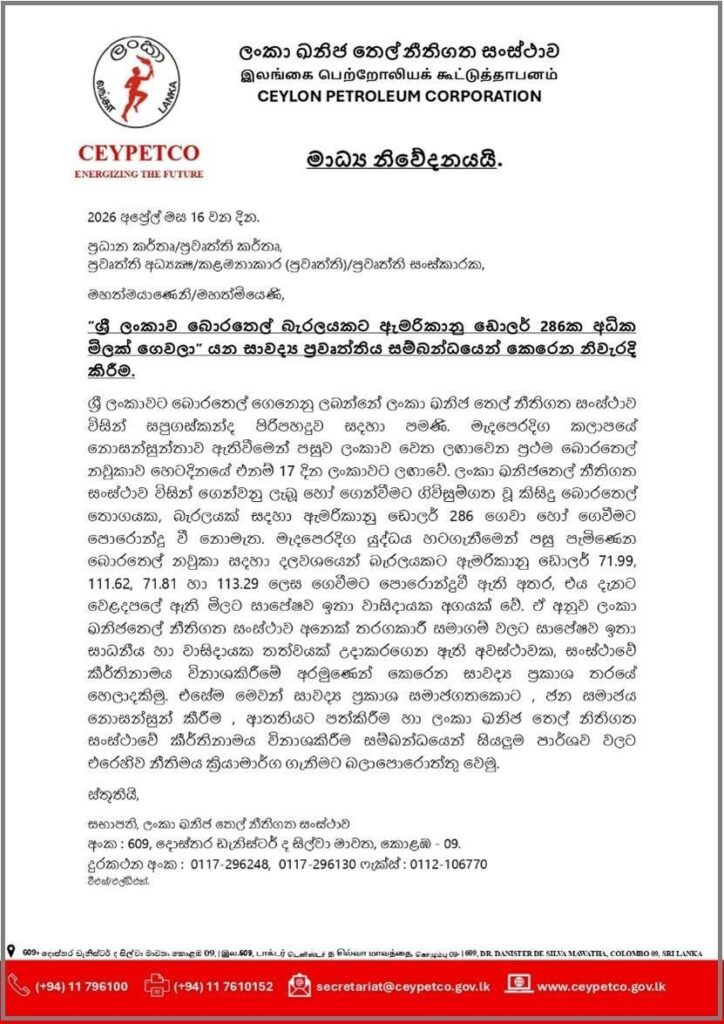
Concurrently, the Chairman of the Ceylon Petroleum Corporation, Janaka Rajakaruna, made a special statement on April 16, stating that the claims that the oil corporation had purchased a barrel of crude oil for $286 were completely false news.
Sri Lanka has purchased diesel for $286, says the chairman of the oil corporation.
At the same time, the Chairman of the Ceylon Petroleum Corporation, calling a media conference on April 17, stated that the corporation had not purchased crude oil for $286 as reported in media reports and that diesel had been purchased for such an amount.
The chairman also stated that there is a question of whether the media misunderstood the CEO’s statement and reported it incorrectly or whether they deliberately spread the word about crude oil.
“Diesel prices have increased significantly. None of us can control that price. If a ship arrives at 5 o’clock in late March or early April, the price of that ship will definitely go to those prices. No one can stop it. The price has increased after the premium value and the world market price are added together. It is not a situation that we can control. If we do not buy oil in this way, the country will lose its oil supply. When the refinery runs out of oil, we have to buy it at the increased prices in the world market. That is the oil that is being used now.”
The chairman stated that there is a big difference between crude oil and refined fuel (diesel and petrol) and that only 20%-30% of the country’s fuel needs are supplied through refineries, while the remaining 70% is supplied through refined fuel.
The Chairman stated that the Ceylon Petroleum Corporation purchased diesel on March 31st at a price of 285.28 per barrel and that the diesel from the ship that arrived on April 7th was purchased at a price of 288.06 US dollars per barrel.
Speaking at a media briefing held at the Government Information Department on April 17, Deputy Minister of Energy Arkam Ilyas also stated that the government has been purchasing crude oil based on the world market index. However, the Deputy Minister also stated that on April 2, the government purchased diesel at $286, while the world market index value at that time was $291.
Speaking at a special media briefing, Minister Bimal Ratnayake stated that having oil in the country is more important than the price paid for it and that Sri Lanka managed the fuel supply very well in the face of the war situation. The minister stated that the government faced the situation in a planned manner and without panic, subject to the procurement principles according to the tender procedure.
Managing Director of the Ceylon Petroleum Corporation
Meanwhile, when we enquired with the managing director of the Ceylon Petroleum Corporation, Dr Mayura Netthikumarage, he stated that several ships arrived on the island at the high prices announced in late March and the first few days of April. Quoting the Managing Director, Sunday Times Archived Link reports:
- On March 31st, 240,000 barrels were purchased at a price of US$285 per barrel.
- On April 6-7th, 295,000 barrels were purchased at a price of US$288 per barrel.
- On April 7-8th, 254,000 barrels were purchased at a price of US$281 per barrel.
Since it was stated that the government purchased diesel for $286 on April 2nd, we checked the price of a barrel of diesel on the world market on those dates. There, we saw that the price of a barrel of diesel in Singapore was around $230.
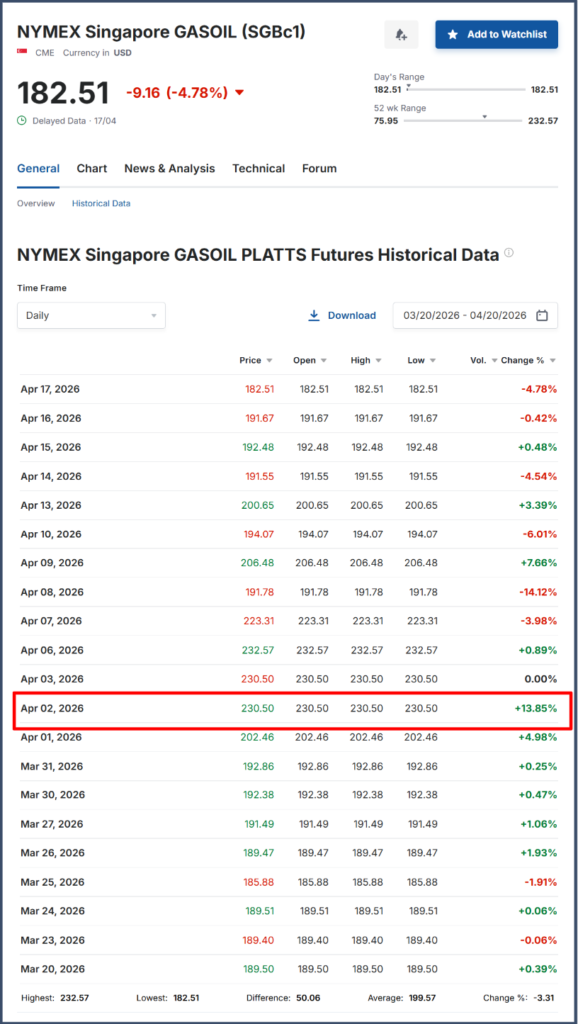
In early April, shipping and insurance surcharges on fuel imports into individual countries added $30-$40 per barrel for delivery to high-risk areas.
The International Energy Agency (IEA) points out that diesel prices in stressed markets have been reported to have reached as high as $290 per barrel.
The Islamic Times reported on April 3 that European diesel futures prices had surged to their highest levels since 2022 as the Iran war curtailed global fuel supplies and blocked key trade routes.
The benchmark contract price on the London market rose by about 9.5%, reaching US$1,493.25 per metric tonne, or more than $200 per barrel, the Anadolu news agency reported.
Join us to learn about our fact-checking efforts
Facebook | Twitter | Instagram | Google News | TikTok

Title: Did Sri Lanka buy crude oil at $286 per barrel?
Fact Check By: Sagarika Chathumali
Result: Insight