

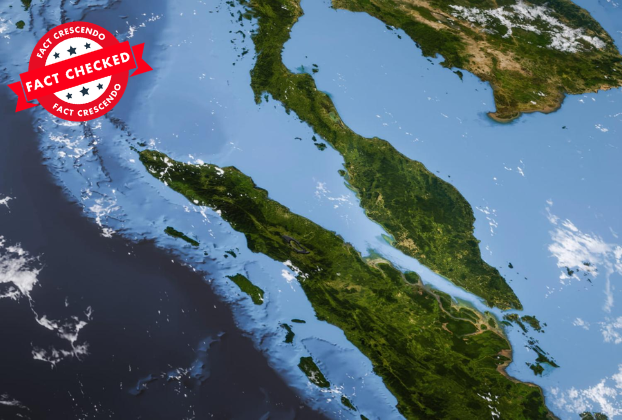
A claim circulating on social media platforms alleges that Indonesia has announced a plan to impose fees on ships transiting the Strait of Malacca, one of the world’s most important maritime routes. However, our fact-check shows that the claim is misleading: while an Indonesian minister floated the idea, the government later clarified that no such plan will be implemented due to legal constraints under international law.
Social Media Posts
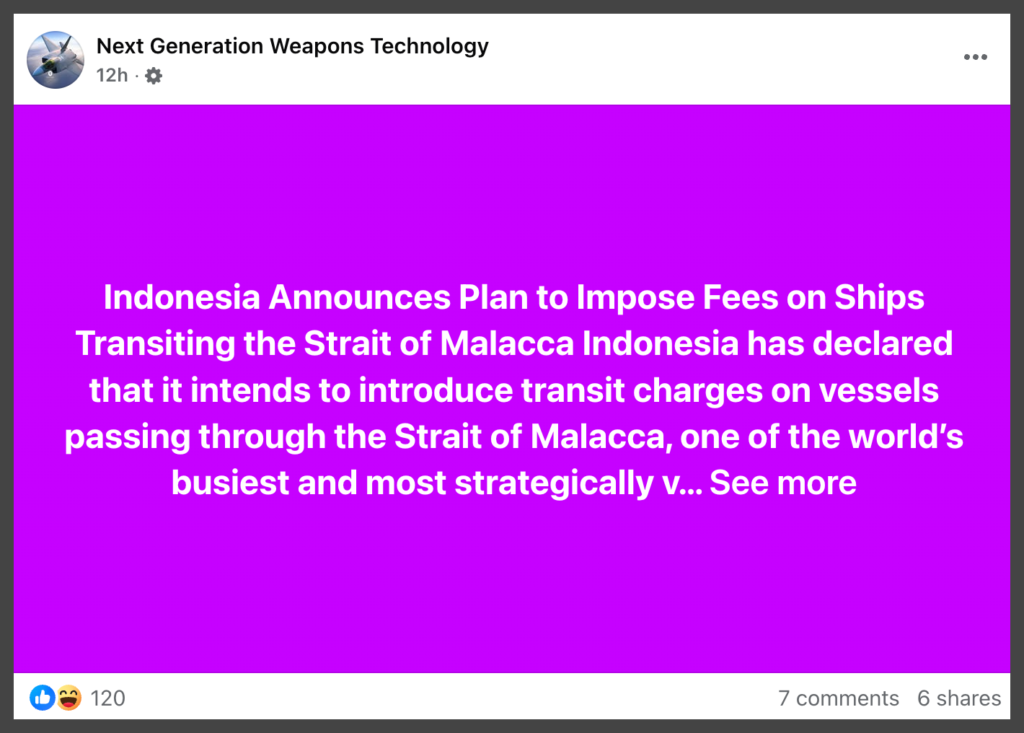
Viral posts state Indonesia has already decided to introduce tolls or fees for vessels passing through the Strait of Malacca. Some versions frame this as a confirmed government policy or an imminent regulatory change.
Examples include posts claiming, “Indonesia announces plan to charge ships using the Malacca Strait,” as seen below.
Fact Check
What was actually proposed
In April 2026, Indonesia’s Finance Minister Purbaya Yudhi Sadewa raised the idea of charging ships that pass through the Strait of Malacca. Channel NewsAsia reported that this was discussed as a conceptual proposal in a public forum, tied to Indonesia’s broader interest in getting more economic value from its strategic location in global trade. The minister pointed out that ships currently transit the strait without paying a direct fee, and suggested exploring whether Indonesia could benefit more from that traffic.
A separate report by FMT also described this as an early-stage idea, not a finalized policy, and noted that any move would require coordination with Malaysia and Singapore, which also border the strait.
Shortly after the proposal gained attention, Indonesia’s Foreign Minister Sugiono clarified that the country will not impose tariffs or levies on vessels transiting the Strait of Malacca. He explicitly stated that such a move would contradict international law and Indonesia’s obligations under UNCLOS (Source).
Legal constraints under international law
The key issue is international maritime law, especially the United Nations Convention on the Law of the Sea (UNCLOS). Under UNCLOS, the Strait of Malacca is treated as a strait used for international navigation, where the rule of “transit passage” applies.
Transit passage means ships and aircraft from all countries have the right to pass through the strait continuously and without unnecessary interference. UNCLOS also makes clear that coastal states must not block or hinder this passage, and they cannot impose charges simply for using the strait. Legal commentary notes that while states can set rules on safety and environmental protection, they cannot levy a toll just for transit (Source).
Experts cited by the Lowy Institute add that tolls in the Malacca Strait would likely breach UNCLOS, and could also weaken Indonesia’s own position as an archipelagic state that relies on similar legal protections
Regional response from Malaysia and Singapore
Malaysia and Singapore publicly pushed back on the idea, saying the Strait of Malacca should stay open to all ships and remain free of transit fees. Singapore’s Foreign Minister Vivian Balakrishnan said the three coastal states (Indonesia, Malaysia, and Singapore) are on the same page about keeping navigation free, and noted that the strait has long been managed through cooperation rather than by charging vessels for passage.
Overall, their response reflects a wider regional view that the strait is a shared international route that underpins global trade, and that any new fees should not be imposed by one country acting alone. (Source)
Why the issue matters globally
The Strait of Malacca is one of the world’s most important maritime chokepoints, carrying a significant portion of global trade and energy supplies. According to Reuters, it handles roughly 22% of global maritime trade and nearly 29% of seaborne oil flows, with over 100,000 ships passing through annually.
Because of this scale, any attempt to impose transit fees could have major implications, including increased shipping costs, rerouting of vessels, and potential geopolitical tensions involving major trading powers.
Conclusion
The claim suggests that Indonesia adopted a formal policy to charge ships using the Strait of Malacca is misleading. Although an Indonesian minister raised the idea of charging ships that pass through the strait, it was never an official government plan. Indonesia’s foreign minister soon clarified that the country will not impose such fees because they would conflict with international law, especially UNCLOS. No policy has been adopted, and the strait remains open for free transit under the current rules.

Title: Indonesia has not announced fees for ships transiting the Strait of Malacca
Written By: Pranpreeya
Result: Misleading