


A claim circulating widely on Facebook and other social media platforms alleges that France has entered a nationwide lockdown because of a hantavirus outbreak linked to the cruise ship MV Hondius. Some posts suggest that the French government has begun imposing COVID-style restrictions and quarantining the public due to fears of human-to-human transmission.
The claim gained traction amid international media coverage of a hantavirus cluster associated with the MV Hondius cruise ship, which carried passengers from multiple countries. However, after reviewing statements from the World Health Organization (WHO), the European Centre for Disease Prevention and Control (ECDC), French authorities, and multiple international news outlets, we found the claim to be false.
Social Media Posts
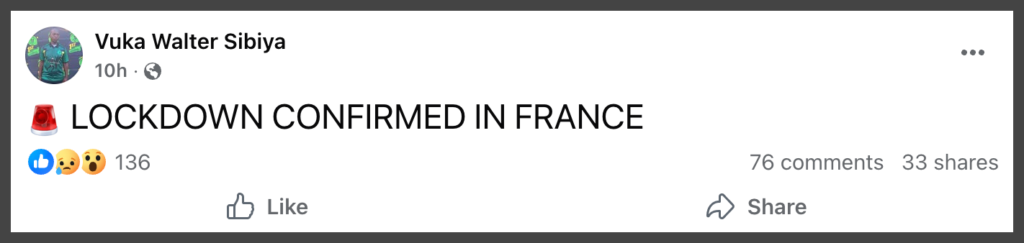
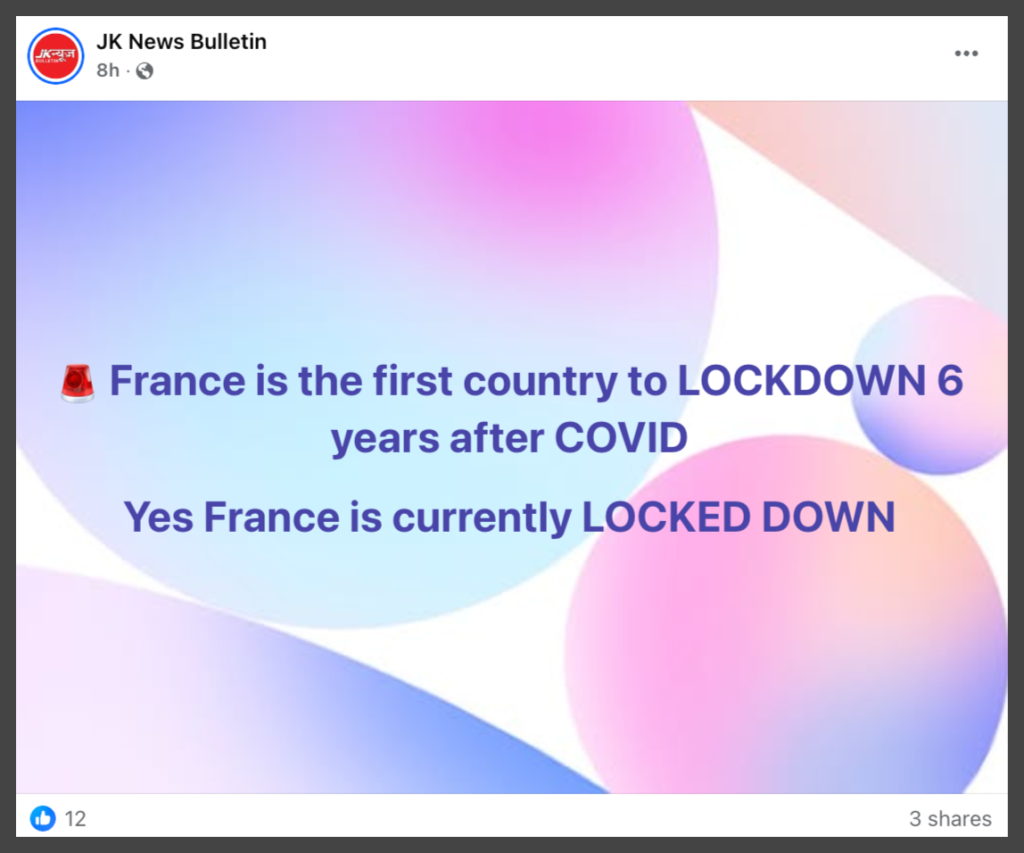
Multiple Facebook posts claimed that “the hantavirus lockdown has officially commenced” in France and alleged that the country was beginning mass isolation measures similar to those seen during the COVID-19 pandemic.
Fact Check
What Is Actually Happening in France?
France has confirmed at least one hantavirus case connected to the MV Hondius cruise ship outbreak. According to reporting by Le Monde and Reuters, the infected passenger was repatriated to Paris and hospitalized at Bichat Hospital.
French authorities also placed several repatriated passengers under strict medical isolation and began tracing approximately 22 potential contact cases connected to international flights used during the evacuation process. Reports indicate these contacts were instructed to self-isolate and monitor symptoms.
However, these measures are targeted public-health interventions focused on identified passengers and close contacts, not restrictions imposed on the broader French population.
No announcement from the French government, Prime Minister’s Office, or Ministry of Health indicates that France has entered a nationwide lockdown, curfew, or stay-at-home order.
France did activate emergency public-health procedures allowing authorities to isolate infected individuals and quarantine close contacts for extended periods. According to Le Monde, exposed individuals linked to the outbreak may face monitoring or quarantine periods of up to 42 days based on WHO guidance.
Additional reporting from The Guardian and Connexion France confirms that the restrictions currently apply only to passengers, identified contacts, and certain hospital monitoring protocols.
There are no nationwide business closures, domestic travel bans, school shutdowns, or broad stay-at-home orders affecting the general public. Most daily activity across France continues as usual.
What Authorities Say About the Public Risk
International health agencies consistently describe the risk to the general public as low.
The WHO Disease Outbreak News update states that the outbreak is linked to a specific cruise-ship cluster and continues to emphasize monitoring, isolation, and contact tracing rather than population-wide restrictions. Similarly, the ECDC said the risk to Europe remains “very low.”
WHO officials have also publicly stressed that this situation is “not another COVID-19.” According to Reuters, WHO epidemic director Maria Van Kerkhove stated: “This is not coronavirus, this is a very different virus.”
Additional reporting from Business Insider and Le Monde likewise notes that WHO does not consider the outbreak to have pandemic-level risk.
Human-to-Human Transmission Concerns
Some social media concern appears to be driven by reports that the strain under investigation may be Andes hantavirus, one of the few hantaviruses associated with limited person-to-person transmission in certain circumstances.
According to WHO and ECDC reporting, authorities are examining whether any limited person-to-person spread may have occurred among close contacts aboard the cruise ship. Public health guidance continues to describe such transmission as uncommon and typically associated with close, prolonged contact.
Unlike respiratory viruses such as COVID-19 or influenza, hantaviruses are primarily rodent-borne and are most often transmitted through exposure to infected rodent urine, saliva, or droppings.
The WHO response update notes that Andes hantavirus is capable of “limited transmission between humans” associated with close and prolonged contact.
Background on the MV Hondius Outbreak
The outbreak was linked to the Dutch cruise ship MV Hondius, which sailed from Argentina in April 2026. According to ECDC assessments and WHO reports, several passengers became ill during the voyage.
As of mid-May 2026, authorities had reported confirmed and suspected cases linked to the ship, including deaths. Passengers from multiple countries were repatriated using medical protocols and monitored upon arrival in their home countries. France was among the countries implementing isolation measures for returning passengers.
This international response has been cited in online posts as support for a lockdown claim, but the measures described apply to identified passengers and contacts rather than the general public.
Conclusion
The claim that France is currently under nationwide lockdown because of hantavirus is false. France has implemented targeted isolation, quarantine, and contact-tracing measures for a small number of passengers and contacts linked to the MV Hondius cruise-ship outbreak. However, there is no nationwide lockdown, curfew, or stay-at-home order affecting the French public.
International health authorities, including WHO and ECDC, continue to assess the overall public risk as low and emphasize that the outbreak is not being treated as a COVID-style pandemic.

Title: France Is Not Under Nationwide Lockdown Due to Hantavirus
Fact Check By: Pranpreeya
Result: False