

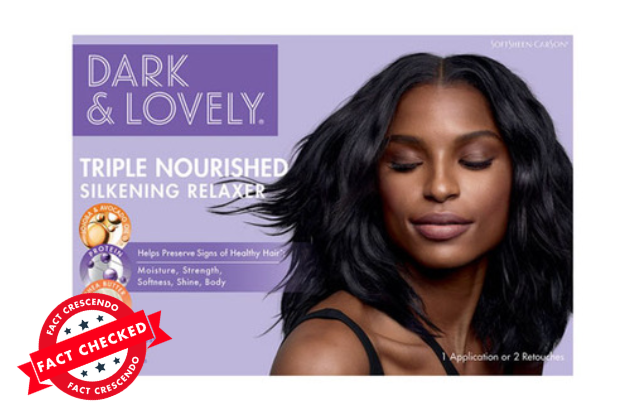
A claim circulating widely on social media platforms alleges that L’Oréal is currently facing more than 11,000 lawsuits because its hair products contain cancer-causing ingredients. Many versions of the claim combine ongoing litigation, epidemiological studies and consumer product testing to suggest that the company has already been proven to have sold dangerous products.
However, these issues are frequently combined without important context. Our review found that the viral claim mixes verified facts with exaggerated and unsupported conclusions, making it misleading.
Social Media Posts
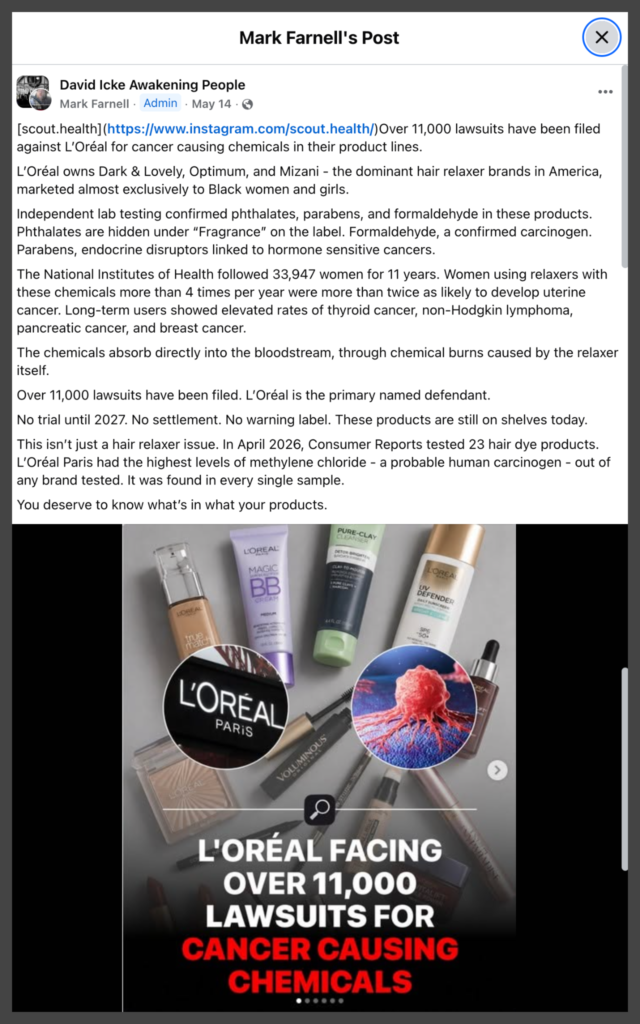
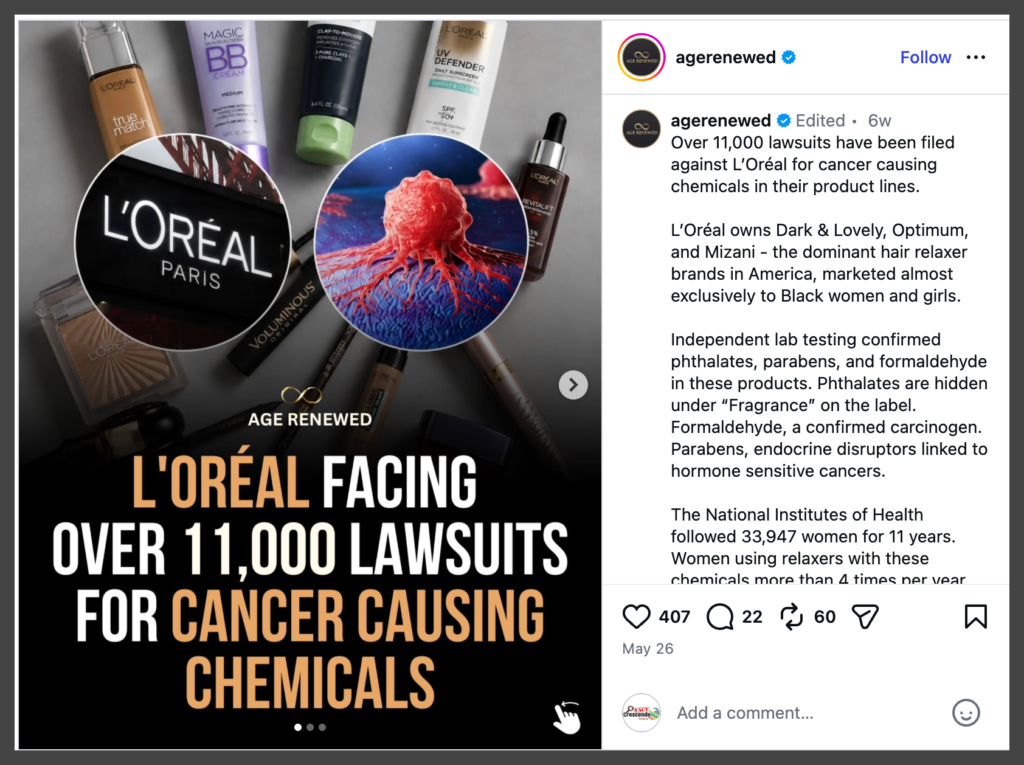
The viral posts generally state that: “Over 11,000 lawsuits have been filed against L’Oréal for cancer causing chemicals in their product lines.”
Fact Check
The “11,000 lawsuits” are not lawsuits against L’Oréal alone
L’Oréal is indeed a defendant in MDL No. 3060 (In re: Hair Relaxer Marketing, Sales Practices, and Products Liability Litigation), which is being coordinated in the U.S. District Court for the Northern District of Illinois before Judge Mary Rowland.
However, the figure of 11,000+ lawsuits refers to the entire multidistrict litigation (MDL) involving numerous manufacturers and distributors, including L’Oréal, Revlon, Strength of Nature, Godrej and several others. It is not the number of lawsuits filed solely against L’Oréal.
Current litigation trackers report roughly 11,800 pending federal cases in mid-2026, but these are consolidated proceedings involving multiple defendants rather than individual lawsuits against one company. (Source)
Therefore, saying that “L’Oréal is facing over 11,000 lawsuits” is an oversimplification that misrepresents the structure of the litigation.
The lawsuits do not establish that L’Oréal’s products are dangerous
Another common misconception is that the existence of thousands of lawsuits proves wrongdoing. In reality, lawsuits are allegations made by plaintiffs. They do not constitute scientific or legal proof.
The litigation alleges that manufacturers failed to warn consumers about potential risks associated with chemical hair relaxers and that long-term exposure contributed to cancers including uterine, ovarian and endometrial cancer.
L’Oréal has denied these allegations. In an official company statement, L’Oréal said it is confident in the safety of its products and does not believe the lawsuits have scientific merit.
Reuters likewise reported that L’Oréal and other manufacturers argue that current scientific evidence does not establish that their products cause cancer.
Although a federal judge allowed most claims to proceed in 2023, that decision merely means the plaintiffs presented legally sufficient allegations for litigation to continue. It is not a ruling that the products caused cancer. (Source)
What the NIH Study Actually Found
A key piece of evidence cited in the viral claim is a 2022 study by the U.S. National Institutes of Health (NIH), which examined whether use of chemical hair products was associated with uterine cancer risk. The study followed 33,497 women aged 35 to 74 in the NIH-led Sister Study for nearly 11 years, during which 378 cases of uterine cancer were diagnosed. Researchers found that women who reported using chemical hair straighteners or relaxers more than four times in the previous year were more than twice as likely to develop uterine cancer as non-users. However, because uterine cancer is relatively uncommon, the estimated absolute risk remained low, increasing from 1.64% among non-users to 4.05% among frequent users by age 70. The study was published in the Journal of the National Cancer Institute and summarized by NIH.
Importantly, the researchers stressed that the study found an association rather than causation. They neither identified the brands participants used nor analyzed the ingredients in those products. As a result, the study cannot determine whether L’Oréal products or any specific chemical caused the observed increase in cancer risk.
Scientists have proposed that endocrine-disrupting chemicals commonly found in some cosmetic products, including certain phthalates, parabens, bisphenols, metals and formaldehyde-releasing compounds, may warrant further investigation.
However, the Sister Study did not determine that any particular ingredient caused uterine cancer. The findings remain epidemiological observations rather than direct toxicological proof.
What about formaldehyde?
Some viral posts imply that formaldehyde is present in all or most hair relaxers. Formaldehyde is classified by the International Agency for Research on Cancer (IARC) as a known human carcinogen under certain exposure conditions.
In 2023, the U.S. Food and Drug Administration (FDA) announced that it was developing a rule to ban formaldehyde and formaldehyde-releasing chemicals as ingredients in hair smoothing and hair straightening products because of evidence linking repeated exposure to respiratory problems and an increased risk of certain cancers. Although the proposed rule has experienced delays and has not yet taken effect, the FDA continues to warn consumers that formaldehyde released during these treatments is a known human carcinogen and advises consumers to avoid products containing formaldehyde, formalin, or methylene glycol. (Source)
However, this regulatory action does not establish that every hair relaxer contains formaldehyde or that every product sold by L’Oréal contains unsafe levels of the chemical. (Source)
Some viral posts also cite a Consumer Reports investigation. Consumer Reports recently detected chemicals including methylene chloride in a range of boxed hair dyes sold by multiple manufacturers. One L’Oréal Paris product contained the highest measured concentration among the products tested. However, these findings concern boxed hair dyes, not the chemical hair relaxers involved in MDL 3060.
The Consumer Reports investigation did not conclude that these products cause cancer in users, nor did it establish regulatory violations. Instead, the organization called for stronger cosmetic safety standards and additional regulatory oversight.
Combining this investigation with the ongoing hair relaxer litigation creates the false impression that all of these findings concern the same products. Hair dyes and chemical relaxers are different product categories formulated for different purposes.
The litigation is still ongoing
The federal hair relaxer litigation remains in its pretrial phase before the U.S. District Court for the Northern District of Illinois as MDL No. 3060, where thousands of lawsuits have been consolidated against multiple manufacturers, including L’Oréal. The court is currently overseeing discovery, evaluating expert scientific testimony, and preparing a group of representative bellwether cases that will serve as test trials. These proceedings are intended to help both plaintiffs and defendants assess how juries may respond to the scientific evidence and legal arguments before the remaining cases move forward.
Importantly, no bellwether trial has yet taken place, no jury has ruled on whether the products caused cancer, and no global settlement has been reached. The litigation is still focused on determining whether the plaintiffs’ scientific evidence is sufficiently reliable to proceed to trial and whether the manufacturers can be held legally liable. As a result, the ongoing lawsuits should not be interpreted as proof that L’Oréal’s products are dangerous or that the company has been found responsible for causing cancer. Bellwether trials are intended to test representative cases and may influence settlement discussions, but they do not determine the outcome of the remaining claims (Source: Reuters, LegalClarity)
Conclusion
The claim that L’Oréal is facing over 11,000 lawsuits regarding cancer-causing ingredients in its hair products is misleading.
Although L’Oréal is a defendant in the multidistrict hair relaxer litigation, the 11,000+ lawsuits involve multiple manufacturers, not L’Oréal alone. Studies like the NIH Sister Study associate frequent hair straightener use with higher uterine cancer risks but do not prove L’Oréal products cause cancer or identify a specific responsible ingredient. The ongoing, unresolved litigation does not establish liability.
Disclaimer: This article is intended for informational purposes only and should not be interpreted as medical advice. Individuals with concerns about cosmetic products or cancer risk should consult qualified healthcare professionals.

Title: Claim That L’Oréal Faces ‘11,000 Cancer Lawsuits’ Lacks Important Context
Written By: Pranpreeya P
Result: Misleading